
Capital Gains Tax Explained - What Every Aussie Investor Should Know

You’re about to sell your investment property, shares, or cryptocurrency, and the numbers on the screen have you calculating the possibilities. But in the shadows, the ATO is waiting to grab its share through Capital Gains Tax (CGT). It’s the tax you pay on the profit you make when you sell certain assets. It’s not a separate tax but considered part of your income tax, which means your capital gains are added to your taxable income for the year.
Getting familiar with CGT is important because it determines how much of your profit you actually keep. It also helps you make smarter decisions when timing a sale, managing your investments, or making super contributions. By the end of this article, you’ll know when CGT applies, how to calculate it, and ways to legally minimise it.
What is Capital Gains Tax?
CGT was introduced in Australia in 1985 and applies when you make a profit on certain assets. The key difference between CGT and regular income tax is that CGT only applies to the gain, not the full sale amount. For example, if you bought shares for $10,000 and sold them later for $15,000, your capital gain is $5,000. That’s what you’ll pay tax on (after any eligible discounts).
When Does Capital Gains Tax Apply?
CGT applies when you make a profit on certain assets or when specific events occur. Knowing which assets and events trigger CGT is essential to plan your sale and avoid surprises.
CGT Assets
Shares and managed funds can trigger CGT when you sell them for more than you paid.
Investment properties, except your main residence, are subject to CGT on any profit you make from the sale.
Cryptocurrency is treated as an asset, so selling, trading, or using it can trigger CGT.
Business assets, such as equipment or part of your business, may generate a capital gain when sold.
Collectibles over $500, like artwork or rare items, are subject to CGT if sold for a profit.
CGT Events
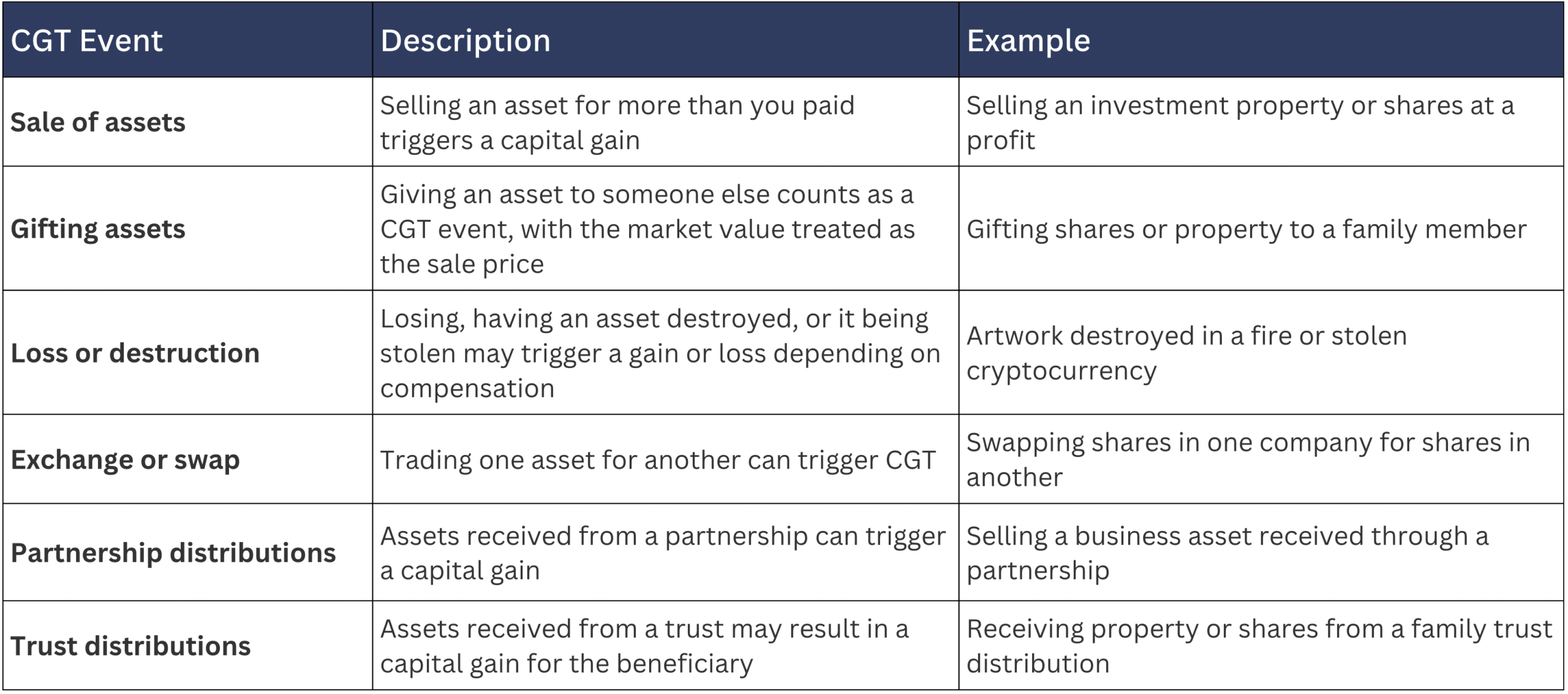
Selling an asset for more than its purchase price is a CGT event.
Gifting an asset is treated as a CGT event, with the market value counted as the sale price.
Losing or having an asset destroyed or stolen can trigger CGT depending on any compensation received.
Capital Gains Tax Rates in Australia
Your capital gains are added to your taxable income and taxed at your marginal income tax rate, which depends on how much you earn in total. For the 2025-2026 financial year, the brackets look like this:
- $0 – $18,200: 0%
- $18,201 – $45,000: 16%
- $45,001 – $135,000: 30%
- $135,001 – $190,000: 37%
- Over $190,000: 45%
There’s no separate “CGT rate,” so your final tax bill depends on your overall income. For example, a $20,000 capital gain will be taxed according to which income bracket it pushes you into, which is why timing and planning matter.
The 50% CGT Discount
If you’ve held an asset for at least 12 months, you could cut your capital gain in half. To qualify, you need to be an Australian resident, and keep in mind that this discount doesn’t apply if you’re a company.
Example: You buy shares for $50,000 and sell them for $100,000 after 18 months. Your capital gain is $50,000. Applying the 50% discount, only $25,000 is added to your taxable income, which can significantly reduce your tax bill.
CGT Exemptions Every Investor Should Know
- Your main residence (primary home)
- Partial exemptions if a property has been used to earn income
- Small personal use assets under $10,000
- Cars and motorcycles
- Collectibles under $500
- Small business CGT concessions
- Inherited assets, where the cost base of the deceased is used
How to Calculate Capital Gains Tax
- Determine the capital proceeds (the sale price).
- Calculate the cost base (purchase price plus costs like stamp duty, legal fees, and agent commissions).
- Subtract the cost base from the proceeds to find your capital gain.
- Apply the 50% discount if eligible.
- Add the resulting amount to your taxable income.
- Calculate tax based on your marginal rate.
Examples:
Shares: You buy shares for $10,000 and sell them two years later for $15,000. This creates a $5,000 capital gain, which is added in full to your taxable income.
Property: You purchase an investment property for $500,000 and spend $20,000 on associated costs. If you sell it for $650,000, your capital gain is $130,000, which is fully included in your taxable income.
Common mistakes include forgetting to include associated costs like stamp duty, legal fees, or agent commissions in your cost base, misrecording important dates such as the purchase or sale date, or incorrectly applying the 50% CGT discount when you’re eligible. These errors can lead to overpaying tax or triggering compliance issues with the ATO, so it’s important to double-check your calculations and keep detailed records.
To make calculating your CGT easier and avoid common mistakes, you can use a CGT Calculator.
CGT on Different Asset Types
Shares
CGT for shares isn’t just triggered when you sell them. Each dividend reinvestment, bonus share allocation, or stock split can count as a separate CGT event. This means you need to keep accurate records of the purchase price, dates, and any additional shares received.
Property
CGT applies to investment properties or any property that isn’t your main residence. You can include costs like stamp duty, legal fees, renovation expenses, and selling costs in your cost base to reduce the taxable gain. The six-year absence rule can also apply if you’ve rented out your main residence while moving elsewhere, allowing partial exemption in certain circumstances.
Cryptocurrency
Every cryptocurrency transaction can be a CGT event, including trades, sales, or using crypto to purchase goods and services. This makes record keeping essential, as each trade needs to be tracked for purchase price, sale value, and date. Failing to maintain accurate records can make calculating gains or losses difficult and increase the risk of errors when reporting to the ATO.
Strategies to Minimise Capital Gains Tax (Legally)
- Hold assets for 12+ months to qualify for the 50% discount.
- Time the sale across financial years to manage taxable income.
- Offset gains with capital losses from other investments.
- Consider contributing to super before selling to reduce taxable income.
- Use main residence exemptions strategically.
- Align asset sales with lower-income years to reduce marginal tax.
Disclaimer: This is general information. Consult a qualified accountant for personalised advice.
Record Keeping & Reporting
Keep detailed records of contracts, receipts, and statements for at least five years. CGT must be reported in the tax return for the financial year in which the asset was sold, not the settlement date. Using accounting software can simplify tracking multiple assets and transactions.
Stay Ahead of the Tax Man
Capital Gains Tax hits the profits you make from shares, property, and other investments, so knowing the rules can save you a serious chunk of money. Keeping accurate records and tracking how long you’ve held assets can make all the difference, and using any exemptions or discounts you qualify for helps protect your returns. When in doubt, get professional advice to make smarter decisions and get the most out of your hard-earned investments. Learn more about how our accountants can help you manage CGT efficiently. If you need some extra help, send us an enquiry or call us on 1300 728 875.

"*" indicates required fields